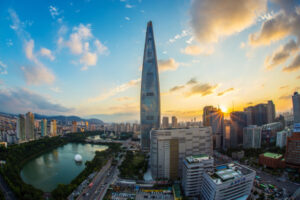
Lotte World Tower
Lotte World Tower (Korean: 롯데월드타워), is a 123-story, 555 m (1,821 ft) supertall skyscraper, located in Sincheon-dong, Songpa-gu, Seoul, South Korea. It is the sixth-tallest building in the world, the tallest in OECD countries, and also the first in South Korea to be over 100 stories tall.
It is a popular tourist spot in Seoul, as the tower and its surroundings offer many excursions. Some popular ones include the Lotte World Aquarium which has an aquarium cafe attached to it.
It also includes the famous Lotte World which is an amusement park. It consists of a large indoor theme park, an outdoor amusement park called "Magic Island", an artificial island on a lake linked by monorail, shopping malls, a luxury hotel, an observation tower, a Korean folk museum, sports facilities, and movie theaters.
Within the Lotte World Tower is a sprawling mall complex that takes up many floors. This mall includes a variety of stores and different types of products, as well as a diverse array of cafes and restaurants.
Lotte World Tower
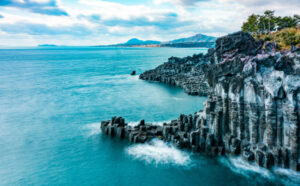
Jeju Island
Jeju Island (제주도) is South Korea's largest island, covering an area of 1,833.2 km2 (707.8 sq mi), which is 1.83 percent of the total area of the country. Alongside outlying islands, it is part of Jeju Province.
The island lies in the Korea Strait, south of the Korean Peninsula, and South Jeolla Province. It is located 82.8 km (51.4 mi) off the nearest point on the peninsula.[2] Jeju is one of two special self-governing provinces in South Korea, meaning that the province is run by local politicians. The Jeju people are indigenous to the island.
It is a common vacation spot for Koreans and foreigners alike. Attractions include hiking along the coast of the island, going on tours of the cliffs, and embarking on boat rides along the perimeter of the island. There are many types of museums and exhibits on the island as well.
Jeju island is known for its citrus fruits that are native to the island, so it is common to see many citrus fruit stands along the streets, as well as shops that sell citrus themed souvenirs. There is an array of seafood restaurants on the island as well.
Jeju Island
Gyeongbokgung Palace
Gyeongbokgung (Korean: 경복궁; Hanja: 景福宮; lit. Blessing Scenery Palace), also known as Gyeongbokgung Palace, was the main royal palace of the Joseon dynasty. Built in 1395, it is located in northern Seoul, South Korea. The largest of the Five Grand Palaces built by the Joseon dynasty, Gyeongbokgung served as the home of the royal family and the seat of government.
Gyeongbokgung continued to serve as the main palace of the Joseon dynasty until the premises were destroyed by fire during the Imjin War (1592–1598) and abandoned for two centuries. However, in the 19th century, all of the palace's 7,700 rooms were restored under the leadership of Prince Regent Heungseon during the reign of King Gojong. Some 500 buildings were restored on a site of over 40 hectares. The architectural principles of ancient Korea were incorporated into the tradition and appearance of the Joseon royal court.
In the early 20th century, much of the palace was systematically destroyed by Imperial Japan during its occupation of Korea. On January 21, 1963, it was designated as a cultural property. Since the 1990s, the walled palace complex is gradually being restored to its original form. It also houses the National Palace Museum and the National Folk Museum within the premises of the complex.
Foreigners or anyone wearing a hanbok (traditional korean clothing) are allowed free admission, so there are many hanbok rental stores around the palace. At Gyeongbokgung Palace, in a program called “Suragan Tasting Sympathy”, visitors can experience royal food and watch traditional performances.
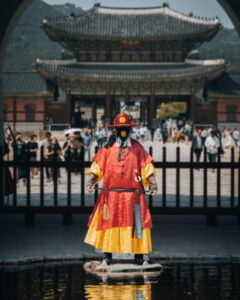
During the Joseon Dynasty, royal guards were in charge of guarding and patrolling the gates of the capital and royal palaces. They played roles by dividing the day and night shifts. Each shift in working hours took place. Today, the changing ceremony of the royal guard (Korean: 수문장 교대의식) in front of Gwanghwamun is recreated just like the Joseon Dynasty. It takes place twice a day.
Gyeongbokgung Palace

Hongdae Shopping Street
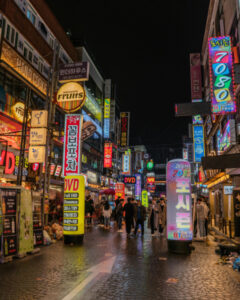
Hongdae (Korean: 홍대) is a neighborhood in Seoul, South Korea near Hongik University, after which it is named. It is known for its urban arts and indie music culture, local shops, clubs, cafés and entertainment. The area is located in Mapo District in the western end of Seoul, stretching from Seogyo-dong, Hapjeong-dong & Seogang-dong.
Under the influence of Hongik University (Hongdae), a prestigious private university known for its Fine Arts Program, the neighborhood was built on a foundation of artistic souls since the 1990s. In the early days, thanks to then-cheap rent, budget musicians and street artists started moving into the ateliers of the Hongdae area. Today, the area provides street art festivals and performances, as well as music concerts by independent artists and mainstream entertainers.
Many come to Hongdae for its aesthetically unique characteristics. There are many graffiti murals painted all over the streets of Hongdae. One of the well known areas for these murals is Hongdae Mural Street (also known as ‘Picasso's Street’).
Like other multi-cultural metropolitan areas, this street is undergoing gentrification. However, despite the recent explosion of upmarket brand shops that pushes artists to move toward the southern area near Hapjeong Station, the street still enjoys a reputation as the city's prime spot for indie musicians. Many live music venues and festivals draw revelers from a wide range of visitors. YG Entertainment, the major K-pop agency is also located near the street.
Many tourists consider shopping in Hongdae a must-do when visiting South Korea, as it is a hub of clubs, cafes, street food, and beauty shopping.
Hongdae
Haeundae Beach
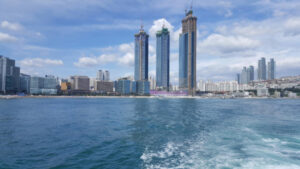
Haeundae Beach (Korean: 해운대해수욕장) is an urban beach in Busan, South Korea, located in the eponymous Haeundae District.
The beach first opened in 1965, and was the largest beach in the country at the time. The sandy portion of the beach is 1.46 kilometres (0.91 mi) long and 40 m (130 ft) wide. It has a parking lot that is handicap accessible.
Haeundae Beach is still considered one of the most famous beaches in Korea, attracting over 10 million visitors every season. The beach is open year-round. Various festivals are held there throughout the year, including the Polar Bear Club, held annually in January since 1988, in which participants bathe in near-freezing water. There is also Haeundae Sand Festival, the only sand-related eco-festival in Korea, which features beautiful sand creations and exciting programs for visitors.
Haeundae is associated with cinema, due to the Busan International Film Festival and the 2009 disaster film Tidal Wave.
The beach has hosted e-sports events for games like StarCraft.
Haeundae Beach is a popular place to stay in Busan, catering to all types of budgets. Along the waterfront, you will find many 5-star hotels, such as Signiel Busan and Grand Josun Busan, as well as less expensive ones, such as Shilla Stay.
Haeundae Beach
Cafe-hopping
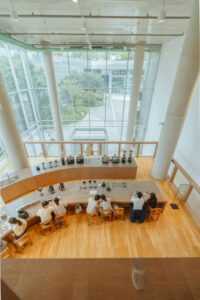
One of the most famous parts of South Korea is their booming cafe culture. The country is known for having an abundance of cafes with creative menus and themes. Foreigners and natives alike often visit cafes, and tourists often partake in what is known as "cafe-hopping", where they visit multiple cafes that they find enticing.
Cafes in South Korea stand out from the west as they are unique in visuals and menu. They are architecturally creative and the interior design is often aesthetically pleasing. The menus often include a variety of foods from drinks, pastas, sandwiches, and desserts.
Cafes in South Korea also often have unique themes, such as animal cafes where customers can interact with animals such as cats, dogs, bunnies, or hedgehogs inside the cafe. Themes such as Studio Ghibli cafes, aquarium cafes, or cafes that are built within a garage such Daelim Changgo are a few.
cafe hopping
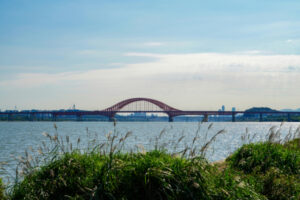
Han River
The Han River or Hangang (Korean: 한강; Korean pronunciation: [ha(ː)n.ɡaŋ])[e] is a major river in South Korea, with some of its tributaries and drainage basin in North Korea. It is the fourth longest river on the Korean peninsula after the Yalu ("Amnok"), Tumen ("Tuman"), and Nakdong rivers. The river begins as two smaller rivers in the eastern mountains of the Korean peninsula, which then converge near Seoul.
The Han River and its surrounding area have played an important role in Korean history. The Three Kingdoms of Korea strove to take control of this land, where the river was used as a trade route to China (via the Yellow Sea).
It is an iconic natural symbol that runs through the center of the capital city of Seoul, South Korea. The construction projects that began in the 1980s to give the Han River a needed makeover have been extremely successful and now there are plenty of things visitors can do to enjoy the scenic waterway. Throughout the year the Han River parks beckon with bike paths, pedestrian friendly walkways, concerts, and more.
The river can be viewed from many surrounding nature parks. You can also ride bikes along the river or take a cruise that goes down the river. It is also common for people to have picnics by the river, and many young people enjoy eating ramen by the riverbank.
Han River