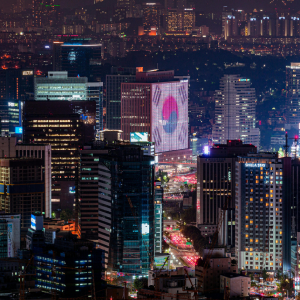
 Legend has it that Korea began with the founding of Gojoseon (also called Ancient Chosun) by the legendary Dangun in 2333 BC. This was eventually followed by the Silla dynasty and then the Goryeo dynasty. Goryeo was then replaced by the Joseon dynasty. The Joseon dynasty ruled Korea from 1392 to 1910, being one of the longest actively ruling dynasties in world history. It was also during this time that the korean alphabet–hangul–was created by King Sejong.
It was in 1910 that the brutal occupation of Korea by Japan began. This rule lasted 35 years, during which Koreans were oppressed and a cultural assimilation policy that included forcing Koreans to take Japanese names and forbidding them to speak the Korean language allowed Japan to maintain colonial control. The Japanese exercised rule of the peninsula until their defeat in World War II in 1945. Japan was forced to surrender the territory and the Allied Powers divided the nation at the 38th Parallel, with the Soviet Union occupying the northern half and the United States occupying the southern half.
North and South each declared independence as separate states in 1948, with Kim Il-Sung establishing a communist regime with the support of Soviet Union in the north, and Syngman Rhee establishing a capitalist regime with the support of the United States in the south. The disastrous Korean War, which destroyed much of the country, began in 1950 when Kim Il-Sung attacked the south. An armistice was signed in 1953 splitting the peninsula along a demilitarized zone. But a peace treaty has never been signed, and the two Koreas remain technically at war with each other to this day.
South Korea achieved rapid economic growth starting in the 1960s under the leadership of former military general President Park Chung Hee. In 1996, South Korea joined the OECD or “the rich nations club”. Today, South Korea has been recognized as an industrialized, developed economy with some of the world’s leading high technology corporations such as Samsung and LG. Koreans believe that the things that set them the most apart from other Asian cultures are their cuisine, their language and their hangul script. Outsiders will note their extreme modernity, tempered by a well-developed artistic and architectural joyfulness. Nothing goes undecorated if it can be helped, and they have a knack for stylish interior design. South Korea also has a vibrant film and TV industry, and the country is one of only a few countries in the world in which local films have a greater market share than Hollywood films.